
Wattreach Workshop · Flow Bench Open beta
See the air before you print the part
Flow Bench puts a velocity stack on a simulated flow bench and shows how the air moves through it: how much gets in, where it separates, and what a change to the lip or the length does. It starts with motorcycle intakes.
Join the beta Have an account? Sign in
Free to use during the beta. You pay only for the runs you start, from a balance you add by card, and a quick run of a round stack is 2 cents. No card to join.
What it is for
Design the stack on screen, not one print at a time
A shop that builds intake parts usually copies the stock stack, changes what it thinks will help, prints it, and finds out on the dyno. Flow Bench moves the finding out to before the print.
- 01
See the air
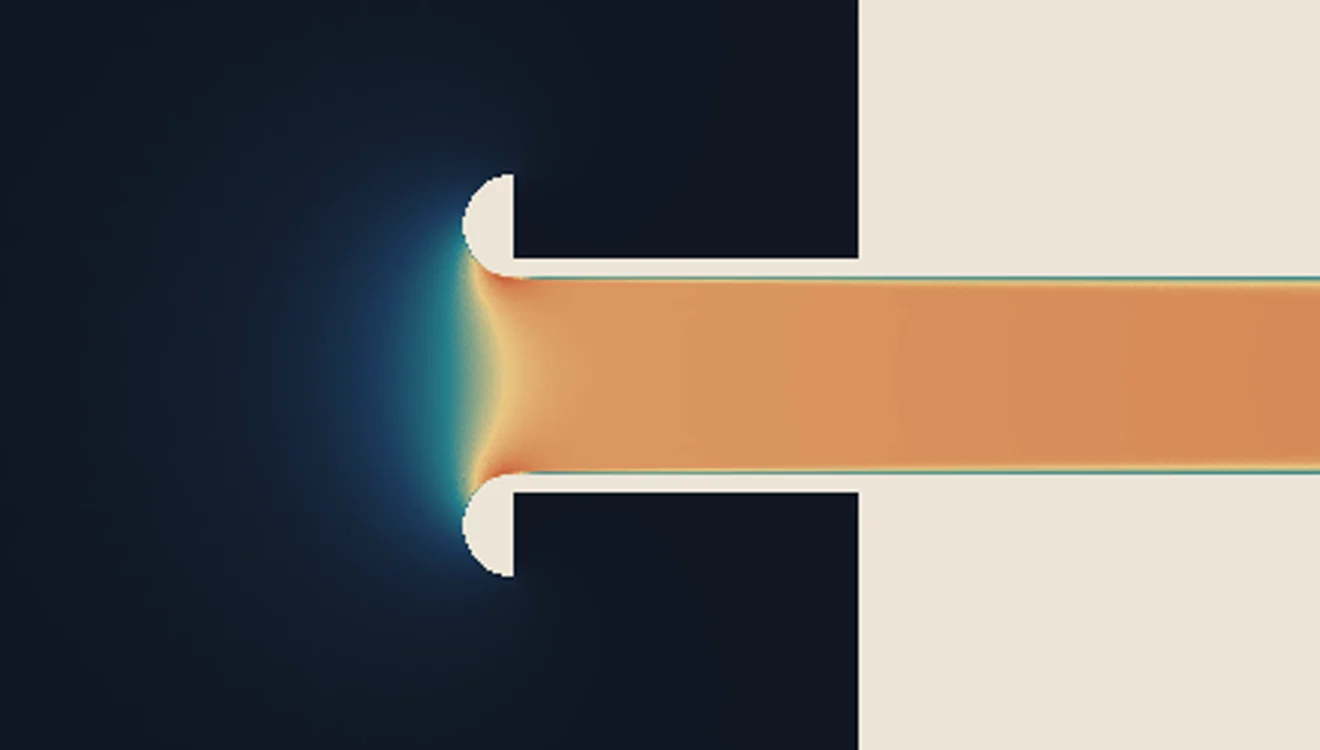
Where it speeds up, where it breaks away from the wall, how much gets through, and where the pressure is lost. The picture above is a real run, and the moving streaks follow that run’s own air. In the bench, the 3D viewer shows the moving air, with slices and sections through it.
- 02
Shape the stack, or bring your own
Type the sizes of a round stack, or shape one that is not round: a lip that varies around the mouth, a tilt, a bell, each with handles to drag. Or upload the part you already have as an STL, 3MF or STEP file, including the files Bambu Studio and PrusaSlicer save.
- 03
Run it quick, or run it full
A quick run gives a first answer: in 2D for a round stack, in 3D for one that is not. A full run is in 3D on two grids, so it reports an error band with its answer. Either can be a sweep: six pressures, from a light pull to a hard one.
- 04
Run the whole intake
Put 2 to 10 stacks together on the bench as a bank, or inside the airbox: type its sizes, put the inlet on any wall, add a duct or a bar across the inlet, the filter’s figures and the road speed. The bench shows each stack’s share of the air, the pressure at its mouth and the angle its air arrives at, with every stack drawing at once or one at a time.
- 05
Keep every test, and compare them
Saved stacks keep their versions, setups are saved, and the history opens every test exactly as it ran. Compare puts up to four tests side by side with their 3D views turning together, and can show just the difference.
Coming next
- Coming
Check it against your dyno
Import back-to-back pulls and the bench shows its prediction over what the dyno measured, with the dyno’s own run-to-run noise drawn in. A change smaller than the noise is not called real.
- Coming
Export to print
When a shape wins, export it as a file to print. Your designs stay private.
Why the mouth matters
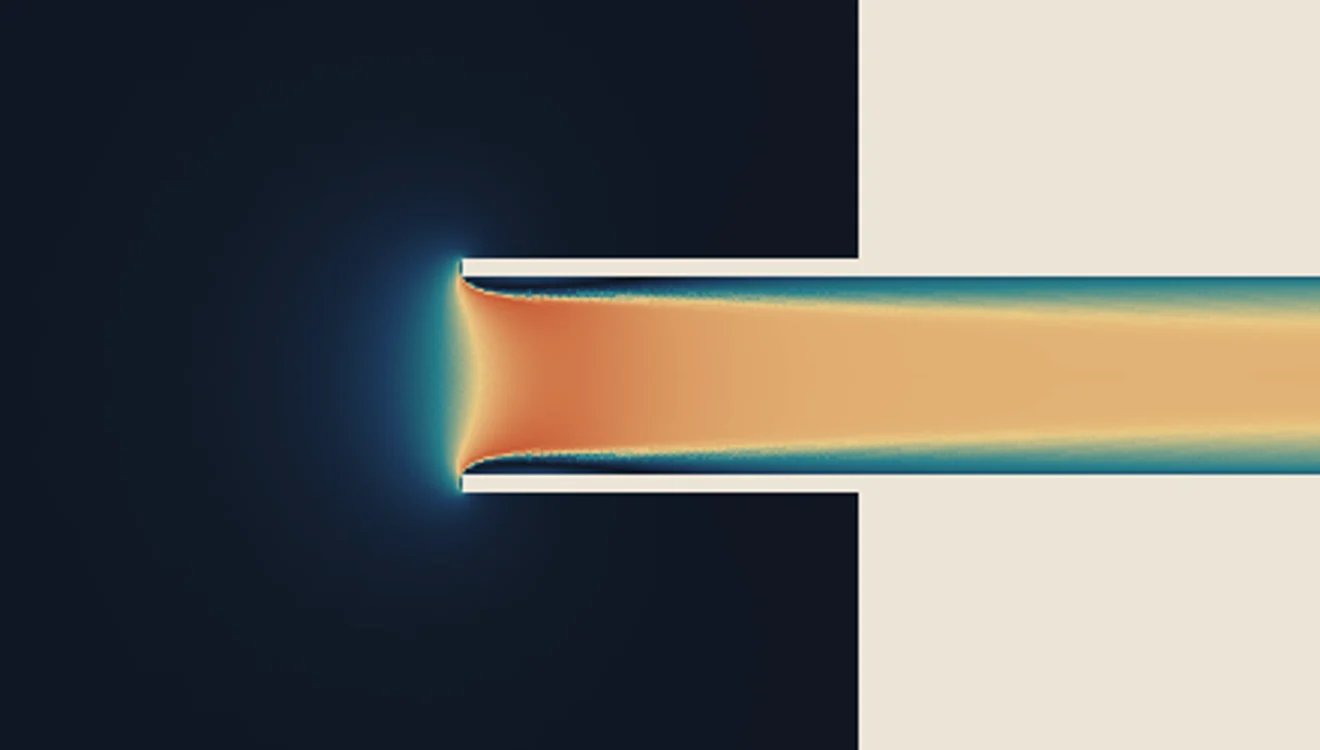
The same pipe, with and without a lip
The guide to the lip and its radius has the third shape, the numbers, and what the published study recommends.
Checked against published figures
How close the bench gets to the published numbers
Blair and Cahoon published flow coefficients for intake pipe mouths in Race Engine Technology. Their figures are computed with a commercial flow solver, and the article shows that solver agreeing closely with flow-rig measurements made at Queen's University Belfast for the plain pipe and the simple radius. Flow Bench ran three of the same shapes. These are the figures at a pressure ratio of 1.04.
| Mouth | Published | Quick run | Full 3D run |
|---|---|---|---|
| Plain pipe, no lip | 0.5676 | 0.5725 +0.9% | 0.5677 +0.0% |
| Simple 6 mm radius | 0.7191 | 0.7181 −0.1% | 0.7210 +0.3% |
| Elliptical bellmouth | 0.7436 | 0.7419 −0.2% | 0.7511 +1.0% |
- Quick runs were also checked at five higher pressure ratios, up to 1.20. All 18 points landed within 1.2% of the published curve.
- A quick run of a round part takes four to six minutes. A full 3D run takes about an hour and a half and runs on two grids, so it can say how much of its answer depends on the grid.
- In 3D, the simple radius has been run at all six pressure ratios and landed within 0.6% at each. The other two shapes have been run in 3D at 1.04 only so far.
- The comparison is with published figures, not with a flow bench of our own. The first shop's bench and dyno are where that check comes from.
- Every run reports its own checks: the grid, the air in against the air out, whether the answer settled. A run that fails one is marked failed and says why.
What it does not claim
A flow number is not horsepower
A part that passes more air on a bench can leave the engine breathing less. One published study (Anaclerio and others, Energies, 2024) found a larger intake plenum passing 9.1% more air in a steady flow test at full valve lift, and then computed 4% to 8% less volumetric efficiency for the running engine at the three speeds it studied. What reaches the cylinder depends on when the intake's pressure waves arrive, and that is set by length and volume as much as by shape. The guide to what a flow bench number means for horsepower has the details.
So no horsepower figure appears here without a dyno behind it. Flow Bench shows how a part flows, the calculator shows where a length puts the wave, and the dyno match, which is coming, is where the two will be held to what the engine did.
For racing use only.
The price during the beta
Free to use. Pay only for the runs you start.
Now, during the beta
Open beta
Free to use no license fee, no card to join
Every screen and tool that is open is yours to use, with as many parts and setups as you like. What you pay for is each run you start, at these prices:
| Run | Price |
|---|---|
| Quick run of a round stackOne pressure, in 2D | $0.02 |
| Quick sweep of a round stackSix pressures, in 2D | $0.14 |
| Quick run of a stack that is not roundOne pressure; it has to be run in 3D | $0.75 |
| Quick sweep of a stack that is not roundSix pressures, in 3D | $4.50 |
| Full runOne pressure in 3D, on two grids, with its error band | $1.00 |
| Full sweepSix pressures in 3D: the whole curve, with every number | $5.00 |
| Stacks together on the bench, or in the airboxFor each full run they count: a bank of four is $4.00, and two stacks in the airbox are $4.00 drawing at once, $20.00 drawn one at a time. | $1.00 each |
How paying works
- Add a balance by card, $50, $75 or $100, and runs are paid from it. No card is asked for until you add one.
- When the balance falls under $10, it is topped up by the same amount. You can turn that off, and it happens at most three times a month.
- Every run shows its price before it starts. A run that fails one of its own checks is given back.
- No runs are included during the beta: each one is paid from the balance.
After the beta
Shop License
$149 a month or $1,490 a year
The price once the beta ends. It starts only if your shop chooses it, and every beta shop is emailed at least 30 days before the beta ends. Balance you have not used stays yours, to use or to have returned.
Included in the license
- Every tool: the viewer and its moving air, the shape editor and uploads, banks and the airbox, saved versions and compare, and the dyno match and export to print when they ship
- Unlimited parts, and 3 people
- Unlimited quick runs of round parts: one pressure, or a sweep of six
- 30 full runs a month, each one pressure in 3D with its error band
Per use, once the included runs are used
- Each full run after the 30
- A full sweep: all six pressures in 3D, the whole curve with every number. It uses five of the 30 first, and costs about $5 after them
- A quick run of a part that is not round, which has to be run in 3D. It uses half of one of the 30 first
Each is priced before it starts: today about a dollar for a full run at one pressure. Every button that starts a run says whether it is included or what it costs.
Per-use runs are paid from a balance of $50, $75 or $100, your choice. It is added the first time you start a per-use run, and again when it runs low.
The license needs a saved card, for the monthly fee and for the balance. A shop that stays inside its included runs never adds a balance, and you can turn the automatic top-up off. A run that fails one of its own checks is never charged and never counted. The stack length calculator and the guides stay free, beta or not.
FAQ
Flow Bench, answered
What people ask before they trust a number from a simulation.
What is a flow coefficient, and is higher better?
It is how much of the pipe the air really uses: the area of the jet at its narrowest, just inside the mouth, over the area of the pipe. Higher is better: more air for the same pull. A plain pipe end with no lip scores about 0.57 at a pressure ratio of 1.04, so the air uses 57% of the pipe; a good bellmouth scores about 0.74. It is the coefficient Blair and Cahoon publish, and it is not the same number as measured flow over ideal flow.
How accurate is it?
On three published mouth shapes, quick runs landed within 1.2% of the published flow coefficients at all 18 points tested, from a pressure ratio of 1.04 to 1.20. Full 3D runs landed within about 1% at 1.04 on all three, and a full 3D sweep of the simple radius landed within 0.6% at all six pressures. The published figures are themselves computed, and their authors showed them agreeing closely with measurements on a flow rig for two of the three shapes. Every run also reports its own checks, and a run that fails one says so.
Does it tell me how much horsepower a part makes?
No, and a flow number alone cannot. A published engine study found a larger intake plenum passing 9.1% more air in a steady flow test, and then computed 4% to 8% less volumetric efficiency for the running engine at the three speeds it studied. Power depends on when the intake’s pressure waves arrive as well as on how much air a part passes, so Flow Bench pairs its runs with the wave timing and, once the dyno match opens, with your own dyno pulls, and it will show a horsepower prediction only with that match behind it.
Can I use it now?
Yes, in open beta. Join below with your email and your shop’s name, and the six-digit code we email you makes your account and signs you in. Every screen and tool that is open is free to use during the beta, and you pay only for the runs you start. The dyno match and export to print are still being built, and come later.
What can I upload?
STL, 3MF and STEP files, including the files Bambu Studio and PrusaSlicer save. A round stack can also be typed in by its sizes, and a stack that is not round can be shaped on screen. A native file from a CAD program needs exporting to STEP first.
What does the beta cost?
Nothing to use it: no license fee, and no card to join. You pay only for the runs you start, from a balance of $50, $75 or $100 you add by card. A quick run of a round stack is 2 cents, a full 3D run at one pressure is $1.00, and a full sweep of six pressures is $5.00. Every run shows its price before it starts, and a run that fails one of its own checks is given back.
What happens when the beta ends?
The Shop License, $149 a month or $1,490 a year with 30 full runs a month included, starts only if your shop chooses it. Every beta shop is emailed at least 30 days before the beta ends. Balance you have not used stays yours, to use or to have returned.
Is this for street bikes?
Flow Bench is for racing use only. Changing the intake of a road vehicle can be against emissions rules where you live, and a printed part inside an intake is your responsibility to make and fit safely.
Flow Bench open beta
Join the beta
Your email and your shop’s name are all it takes. We email you a six-digit code, and the code makes your account and signs you in. Free to use during the beta; you pay only for the runs you start.
Already have an account? Sign in to the bench.

Follow along
Follow the trip
We'll post photos, video, and the next morning's plan as we go.